From Self-Help Groups to Small Businesses: How Uttarakhand’s Rural Women Are Turning Enterprise into Income
With market access, structured support and entrepreneurship training, the Pushkar Singh Dhami government’s Shashakt Behna and Lakhpati Didi initiatives are helping rural women move from making products to building viable businesses
By Sanjay Pandey
Dehradun: For thousands of women in Uttarakhand’s villages, this Raksha Bandhan was not just about tying a thread of affection—it was also about creating a new source of income.
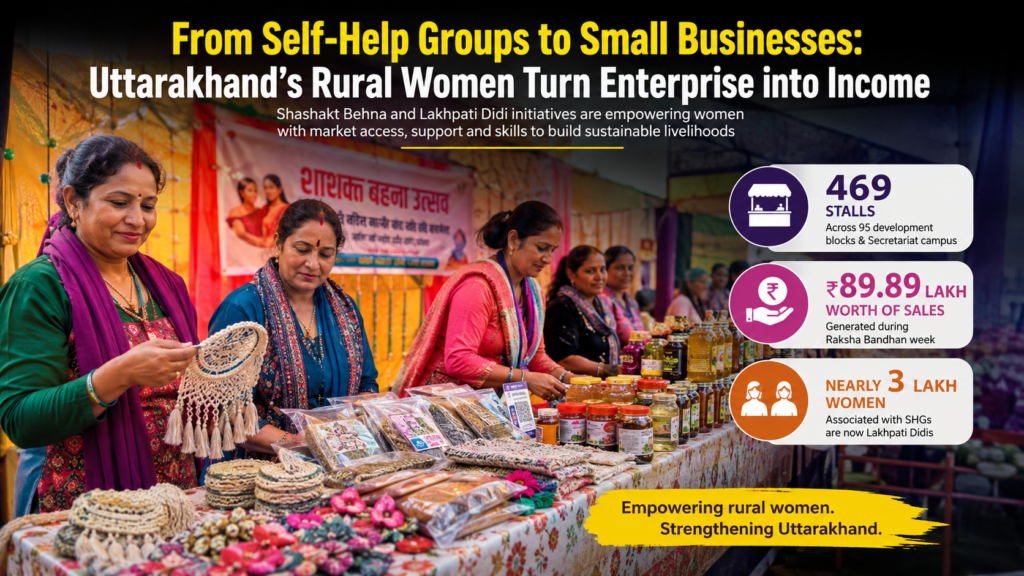
Across the state, women associated with Self-Help Groups (SHGs) sold products worth ₹89.89 lakh through 469 stalls set up across 95 development blocks and the Secretariat campus under the Mukhyamantri Sashakt Behna Utsav Yojana.
The numbers point to a larger shift taking place at the grassroots: rural women are increasingly moving beyond traditional handicrafts and household production towards organised micro-enterprises, learning how to price, package, market and sell their products directly to consumers.
The week-long initiative, which began on August 21, provided SHGs with a physical marketplace at a time when demand for locally made products typically rises around Raksha Bandhan. More importantly, it connected women producers with consumers without the traditional layers of intermediaries.
For the state government led by Chief Minister Pushkar Singh Dhami, such interventions are part of a broader strategy to turn women’s collectives into sustainable sources of household income and local economic activity.
From making products to managing businesses
The significance of these initiatives lies not merely in the sales generated during a festival.
For rural women, access to a market can be as important as access to finance. A woman may possess the skill to weave, process food, make handicrafts, prepare traditional products or manufacture other locally relevant goods, but without a reliable market, that skill often remains a household activity rather than becoming an enterprise.
The Shashakt Behna initiative attempts to bridge precisely this gap.
By providing SHGs with stalls and market platforms, the programme gives women an opportunity to experience the complete business cycle—understanding consumer demand, displaying products, interacting with customers, negotiating prices, maintaining sales records and reinvesting earnings.
In the process, traditional skills are beginning to acquire an entrepreneurial dimension.
The intervention also creates a feedback loop. Direct interaction with consumers allows women producers to understand which products sell, what price points work and where improvements in packaging, quality and presentation are required.
That learning can be critical for cottage industries attempting to transition from local production to larger markets.
The Lakhpati Didi effect
The state’s focus on women-led enterprise is also reflected in the Lakhpati Didi initiative.
Nearly three lakh women associated with SHGs in Uttarakhand have become Lakhpati Didis, according to the state government.
The significance of the number goes beyond income classification. It represents an effort to create a larger base of rural women who can generate annual household incomes of at least ₹1 lakh through livelihood activities.
This is where the intersection of the Shashakt Behna and Lakhpati Didi approaches becomes important.
While one focuses strongly on creating opportunities for women to take their products to consumers, the other seeks to push women towards higher and more sustainable income levels.
Together, they are helping create an ecosystem in which a rural woman is not viewed merely as a beneficiary of a welfare programme but increasingly as a producer, entrepreneur and economic decision-maker.
Market access is the missing link
For Uttarakhand, where villages are dispersed across difficult Himalayan terrain, market access has traditionally been one of the biggest challenges for small producers.
A good product made in a remote village does not automatically become a successful business.
It needs branding, packaging, pricing, logistics, customer access and repeat demand.
Government-supported exhibitions and sales platforms can therefore serve as a low-cost entry point for women entrepreneurs to test their products in real markets.
The Raksha Bandhan intervention demonstrated the potential of this model.
With 469 stalls operating across the state, the programme created multiple decentralised marketplaces rather than concentrating sales in a single urban location.
The ₹89.89 lakh in sales generated during the week offers an early indicator of consumer acceptance—and, perhaps more importantly, gives participating women a tangible understanding of what their skills can translate into economically.
Building confidence along with income
The economic impact of such interventions is not restricted to the cash generated.
For many women, the first experience of independently selling their products can be a confidence-building exercise.
Handling customers, deciding prices, maintaining accounts and understanding demand are basic business skills, but acquiring them can fundamentally change the way women perceive their own economic capabilities.
“Women’s Self-Help Groups are being connected with self-employment and efforts are underway to make them economically self-reliant. The sales achieved through the stalls provided by the department during Raksha Bandhan have boosted the enthusiasm of women,” said Bharat Singh Chaudhary, Uttarakhand’s Rural Development Minister.
That confidence can potentially translate into the next stage—larger production, better product quality, stronger branding and greater participation in formal markets.
From welfare to enterprise
The larger policy story emerging from Uttarakhand is therefore less about one festival or one sales figure and more about changing the architecture of rural livelihoods.
The state’s intervention is attempting to move women’s SHGs along a continuum—from skill and production, to market access, to income generation, and ultimately to enterprise ownership.
For a hill state where migration and limited livelihood opportunities remain structural challenges, strengthening village-level enterprises can have an economic multiplier effect.
When women earn locally, household purchasing power rises locally. When production is based on local resources and traditional skills, value can remain within the village economy. And when women begin managing businesses, the economic benefits can extend beyond individual households to the wider rural ecosystem.
The ₹89.89 lakh generated during Raksha Bandhan may therefore be viewed not simply as festival-season sales.
It is a snapshot of a larger experiment underway in Uttarakhand—one where government intervention is increasingly focused not merely on providing livelihood support, but on creating women entrepreneurs capable of taking their own products, skills and enterprises to the market.
For the Dhami government, the bigger challenge now will be to convert these periodic marketplace successes into sustained businesses—with stronger branding, e-commerce access, institutional procurement, logistics support and continuous skill upgradation.
If that transition succeeds, the real measure of the Shashakt Behna and Lakhpati Didi initiatives will not be the number of stalls set up or products sold at a festival.
It will be the number of rural women who eventually no longer need a government stall to find a market.
Himalayan Live Bureau